Pulse Radio Frequency Awakens Dormant Nerves After Stroke, Says Dr. Adam Klotzek
Dr. Joseph Schneider has spent over 35 years treating stroke, neuropathy, and neurological injury, but his approach transformed when he discovered Stimpod pulse radio frequency technology and its reported ability to awaken nerves that conventional medicine often considers permanently damaged. In this episode of My POTS Podcast, host Dr Schneider has a technical conversation with Dr. Adam Klotzek,, a medical device expert and pulse radio frequency specialist, Dr. Schneider describes patient outcomes that include wheelchair-bound stroke survivors regaining motor control after single treatments. The central insight reframes neurological recovery: nerves do not necessarily die after injury; they may enter a dormant state while awaiting metabolic restoration that pharmaceutical medicine does not address.
About This Blog
Dr. Joseph Schneider has spent over 35 years treating stroke, neuropathy, and neurological injury, but his approach transformed when he discovered Stimpod pulse radio frequency technology and its reported ability to awaken nerves that conventional medicine often considers permanently damaged. In this episode of My POTS Podcast, host Dr Schneider has a technical conversation with Dr. Adam Klotzek,, a medical device expert and pulse radio frequency specialist, Dr. Schneider describes patient outcomes that include wheelchair-bound stroke survivors regaining motor control after single treatments. The central insight reframes neurological recovery: nerves do not necessarily die after injury; they may enter a dormant state while awaiting metabolic restoration that pharmaceutical medicine does not address.
Research cited in PubMed Central clinical literature suggests that pulse radio frequency produces nerve modulation rather than destruction through the combined use of 500 kHz radio frequency and a 2 Hz pulse frequency. This approach promotes periodic ion channel opening while avoiding the heat accumulation associated with continuous high-frequency current. These parameters differentiate modern pulse radio frequency from earlier nerve ablation techniques developed in the 1960s, which relied on thermal damage to disrupt pain fibers. This evolution helps explain why Stimpod is described as producing outcomes not seen with traditional electrical stimulation or medication-based interventions alone.
Nerve Destruction to Nerve Awakening
Radio frequency technology emerged in the 1960s and 1970s as an ablation method designed to destroy nerves associated with chronic pain. The method relied on continuous radio frequency waves that generated sufficient heat to damage nerve tissue, particularly pain fibers lacking protective myelin sheaths. Pain relief was achieved by disrupting signal transmission through nerve destruction.
A major shift occurred when researchers observed that pulsed radio frequency could produce pain reduction without destroying nerve tissue. This transition from continuous to pulsed delivery marked the development of modern pulse radio frequency therapy. Later advances allowed transcutaneous application rather than invasive nerve access, enabling the non-invasive approach used by Stimpod today.
Dr. Adam Klotzek explains that Stimpod combines two modalities often separated in nerve stimulation devices. The system delivers radio frequency waves alongside galvanic stimulation. Each visible muscle twitch represents nerve activation that sends signals to the brain and receives feedback in return, creating bidirectional communication that engages broader neural networks rather than isolated nerve pathways.
Nerves Go Dormant Like Grass in Winter
A common misconception surrounding stroke and neuropathy is the assumption that nerve tissue dies permanently. When patients hear the phrase “permanent nerve damage,” they often believe regeneration is impossible. Dr. Adam Klotzek explains that nerve cell bodies may remain viable after injury but enter metabolic dormancy when ATP production and action potential propagation become impaired.
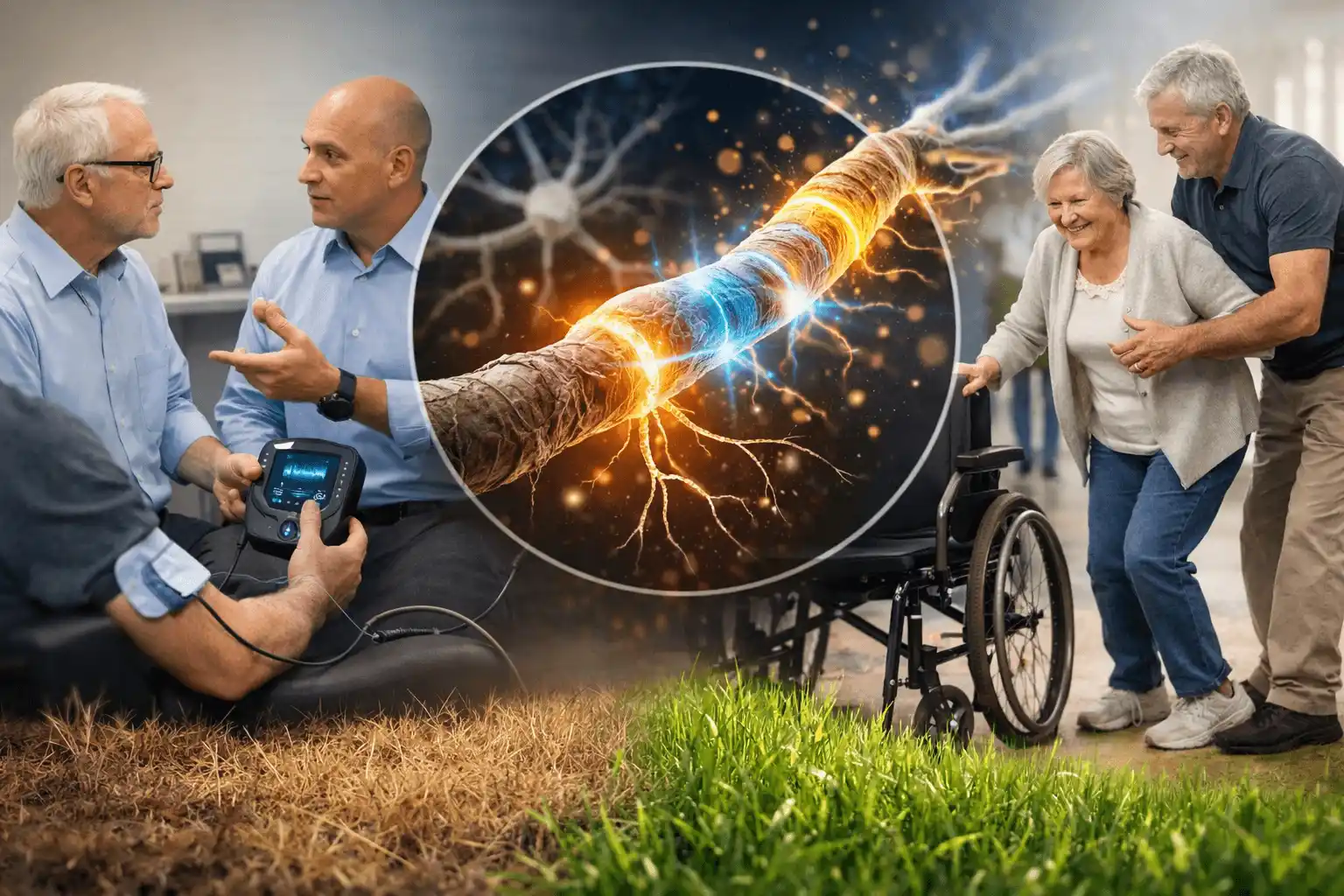
The analogy of grass during winter or drought illustrates this mechanism. Although the visible plant appears dead, the root system remains alive and capable of recovery when conditions improve. Similarly, axonal degeneration may occur after stroke or neuropathy, but surviving nerve cell bodies can remain dormant. When metabolic conditions improve, regeneration may occur.
This perspective also explains why conventional electrical stimulation can yield limited results. Electrical impulses alone cannot restore function if nerves lack sufficient metabolic capacity. The challenge is not inadequate stimulation, but insufficient cellular energy production.
Immune System ATP Donation and Metabolic Support
Pulse radio frequency is described by Dr. Klotzek is addressing this metabolic limitation. He proposes that pulse radio frequency signaling encourages immune-mediated support, including ATP and mitochondrial transfer to dormant nerve cells. This process is described as jump-starting cellular metabolism, enabling nerves to resume energy production and functional signaling.
The comparison to jump-starting a car battery illustrates the concept. The electrical system remains intact, but function resumes only after sufficient energy is restored. Pulse radio frequency is proposed to provide the initial metabolic stimulus that allows nerves to recover autonomously.
Dr. Schneider emphasizes that mitochondria represent only one component of cellular recovery. Full nerve restoration also requires endoplasmic reticulum function, epigenetic regulation, and neurotransmitter synthesis. The combined metabolic effects described are presented as a reason pulse radio frequency may produce outcomes not achieved with pharmaceutical approaches.
Wheelchair Stroke Patient Gained Tongue Control
One of Dr. Schneider’s most notable cases involved an elderly chiropractor’s wife who suffered a severe stroke that left her wheelchair-bound with major motor impairment. While cognitive function remained intact, she lost the ability to walk independently and lacked tongue control necessary for basic tasks such as holding a straw.
Treatment initially targeted leg swelling through tibial nerve stimulation using Stimpod pulse radio frequency. While swelling reduction was expected, an unexpected outcome followed. After a single session, the patient regained voluntary tongue control. She could protrude her tongue on command, move it vertically and laterally, and perform coordinated movements.
Her husband contacted Dr. Schneider is in disbelief. Treating the leg appeared to restore tongue function. This outcome is presented as evidence of pulse radio frequency’s systemic neurological effects. Peripheral nerve stimulation may engage broader neural networks, including brain pathways rendered inactive after stroke.
Tremor Frequency Progression Not Yet Documented
Dr. Schneider also reports observing a consistent pattern during tremor treatment using pulse radio frequency. Patients with low-frequency tremors reportedly experience an increase in tremor frequency before resolution. He notes that this sequence has not yet been formally published.
Dr. Klotzek recognized the significance of this observation and encouraged documentation. Unlike pharmaceutical tremor management, which suppresses symptoms, this pattern suggests active neurological recalibration.
Dr. Schneider interprets this progression as refinement of motor control systems. Tremors shift from broad, low-frequency oscillations to tighter, higher-frequency movements as feedback mechanisms improve before stabilizing completely. This process contrasts with symptom suppression that does not restore underlying control.
Why Certain Medications May Degrade Nerve Function
The discussion also addresses medications commonly prescribed after stroke. Calcium channel blockers used for blood pressure control and gabapentin prescribed for nerve pain are described as interfering with action potential generation across nerve membranes. Over time, this interference may contribute to Wallerian degeneration and progressive nerve dysfunction.
Dr. Schneider stresses that stroke patients benefit from preserving remaining neural function. When medications compromise metabolic or electrical integrity, functional decline may continue. His approach involves coordinating care to reduce medication reliance while improving nerve function through pulse radio frequency interventions.
Oxygen Training Compared With Hyperbaric Therapy
Dr. Schneider describes moving away from hyperbaric oxygen therapy after two decades of use. Challenges included maintenance demands, infection control concerns, and limited benefit compared with simpler oxygen protocols. He reports that brief sessions of high-intensity oxygen training using concentrators yielded superior clinical outcomes.
This method involves short hypoxic intervals, reducing oxygen saturation to approximately 70 percent, followed by rapid reoxygenation within 30 to 45 seconds. This cycling is described as enhancing autonomic regulation and supporting ATP production. When combined with hydrogen therapy, these protocols are reported to outperform hyperbaric oxygen in neurological rehabilitation settings.
Activating Dormant Nerves Through Metabolic Support
Dr. Schneider’s integration of pulse radio frequency therapy at Hope Brain Body Recovery Center reflects a treatment philosophy focused on metabolic restoration rather than symptom suppression. Viewing nerves as dormant rather than dead shifts rehabilitation toward regeneration rather than compensation.
Listeners interested in pulse radio frequency therapy, Stimpod technology, and stroke recovery can explore the full discussion on My POTS Podcast and visit HopeBrainCenter.com. The concept that immune-mediated metabolic support may restore dormant neural function reframes recovery potential for stroke, neuropathy, and neurological injury.
Connect with Dr. Joseph Schneider:
Website: Hope Brain and Body Recovery Center; Hope Regeneration Center
Podcast: MyPOTSPodcast.com
LinkedIn: Joseph Schneider
YouTube: HopeBrainBodyRecoveryCenter
Instagram: @HopeBrainCenter_
Facebook: Hope Brain and Body Recovery Center
Connect with Dr. Adam Klotzek:
LinkedIn: Adam-Klotzek-DC-MS-DACNB-FICC
Twitter: @AKlotzek21
Related Blog
Duis mi velit, auctor vitae leo a, luctus congue dolor. Nullam at velit quis tortor malesuada ultrices vitae vitae lacus. Curabitur tortor purus, tempor in dignissim eget, convallis in lorem.



Comments