Find the Precise Activity Balance POTS Patients Need Between Atrophy and System Crashes
Dr. Joseph Schneider brings more than 35 years of functional neurology experience treating POTS and dysautonomia patients who struggle to find the precise activity balance between under-doing, which causes atrophy, and overdoing, which triggers debilitating crashes. His unique background combines engineering physics with power plant control systems expertise, creating clear metaphors for understanding autonomic nervous system regulation that conventional medicine often overlooks. In this New Year’s Eve solo episode of My POTS Podcast, Dr. Schneider delivers a focused message about finding your personal “do” level, where metabolic state supports efficient function without overwhelming dysregulated systems.
About This Blog
Dr. Joseph Schneider brings more than 35 years of functional neurology experience treating POTS and dysautonomia patients who struggle to find the precise activity balance between under-doing, which causes atrophy, and overdoing, which triggers debilitating crashes. His unique background combines engineering physics with power plant control systems expertise, creating clear metaphors for understanding autonomic nervous system regulation that conventional medicine often overlooks. In this New Year’s Eve solo episode of My POTS Podcast, Dr. Schneider delivers a focused message about finding your personal “do” level, where metabolic state supports efficient function without overwhelming dysregulated systems.
Dr. Schneider observes daily at the Hope Brain Body Recovery Center that POTS patients face an impossible choice between maintaining enough activity to prevent deconditioning and avoiding exertion that causes multi-day crashes. Understanding control system principles from engineering explains why autonomic dysfunction creates this catch-22 and how systematic rehabilitation can restore balance.
The Brain as Master Control System
Before becoming a functional neurologist, Dr. Schneider earned an engineering physics degree from St. Joseph’s University and worked at Omni-Data designing simulators for power plants. His role focused on process control and control system technology, training power plant operators to run facilities efficiently without damaging million-dollar equipment. The objective was to lower fuel input while maximizing kilowatt output, minimize toxic emissions through stack cleaning systems, and optimize operations for peak performance.
When debilitating back pain led him to visit a chiropractor despite skepticism, Dr. Bill Oliver reviewed full-spine X-rays and demonstrated how spinal segment dysfunction affected the body’s control systems. He explained that the brain functions as the master control system of the body. For Dr. Schneider, the concept resonated immediately. The brain operates like a power plant’s master controller, with the spinal and peripheral nervous systems acting as subsystems that communicate continuously with the central control unit.
This insight changed his career path. Despite his supervisor, Art Schultz, warning that leaving a high-performing engineering role to take on student loans for chiropractic school would be financially risky, Dr. Schneider pursued functional neurology. He enrolled at New York Chiropractic College to study the brain, spine, and peripheral nervous system as interconnected automatic control systems that should operate as efficiently as power plants.
POTS as Control System Failure
The autonomic nervous system is an involuntary control system operating continuously in the background to support conscious activity. When functioning properly, heart rate, blood pressure, breathing, temperature regulation, and circulation self-regulate without conscious effort. POTS and dysautonomia represent control system failure, where the master controller in the brain cannot effectively communicate with spinal and peripheral subsystems.
This breakdown creates classic POTS symptoms. Standing causes heart rate to spike above 110 to 120 beats per minute and remain elevated or struggle to normalize. Fine-tuned autonomic regulation is lost. Central circulation to the brain, peripheral circulation to the extremities, adrenal and thyroid regulation, immune signaling through the thymus, and metabolic energy production all depend on intact autonomic communication.
Although exercise is commonly prescribed, most POTS patients, especially those with severe orthostatic intolerance and fatigue, cannot complete or sustain rigorous exercise programs or integrate them into daily life. This creates the under-doing versus over-doing dilemma that prevents progress until patients identify their personal “do” level.
Most POTS Patients Breathe Wrong
The phrenic nerve that controls diaphragmatic breathing originates at C2, C3, and C4 in the cervical spine, traveling from the medulla in the brainstem through the neck and past the heart to innervate the diaphragm on both sides. This system should automatically coordinate breathing through diaphragm contraction and relaxation. However, many POTS patients compensate by expanding the rib cage rather than using proper diaphragmatic breathing.
This compensation creates chronic problems. Muscles attached to the upper ribs, including the scalenes, trapezius, and sternocleidomastoid muscles, work excessively to draw air into the lungs. These muscles become imbalanced, dystonic, and locked in sustained spasm. Over time, incorrect breathing patterns contribute to hyper-mobility in the upper and lower cervical spine, tight anterior rib heads, and persistent neck pain that is often treated as a separate issue rather than a breathing dysfunction.
When phrenic nerve signaling and diaphragmatic function are impaired, the diaphragm weakens through disuse. Patients then struggle to move adequate air volume and may become hypoxic during activity because they are not reaching full tidal capacity. Exercise combined with oxygen exposure can help retrain these control mechanisms while identifying potential phrenic nerve compression or brainstem dysfunction affecting coordination.
Finding Your Marathon Training Pace
Dr. Schneider uses marathon training as a practical metaphor for POTS rehabilitation. If someone can currently run two miles efficiently and aims to complete a 26-mile marathon, the process requires gradual progression. For fit individuals, this may take six months. For those with poor conditioning, excess weight, or metabolic dysfunction, it may take up to two years.
The principle is incremental stress. Systems must adapt slowly to increased demands without breaking down. When marathon running gained popularity, many people were injured because they advanced too quickly. Dr. Schneider reflects on his own marathon attempts, where working long hours, training late, and neglecting recovery led to hitting the wall rather than achieving sustainable performance.
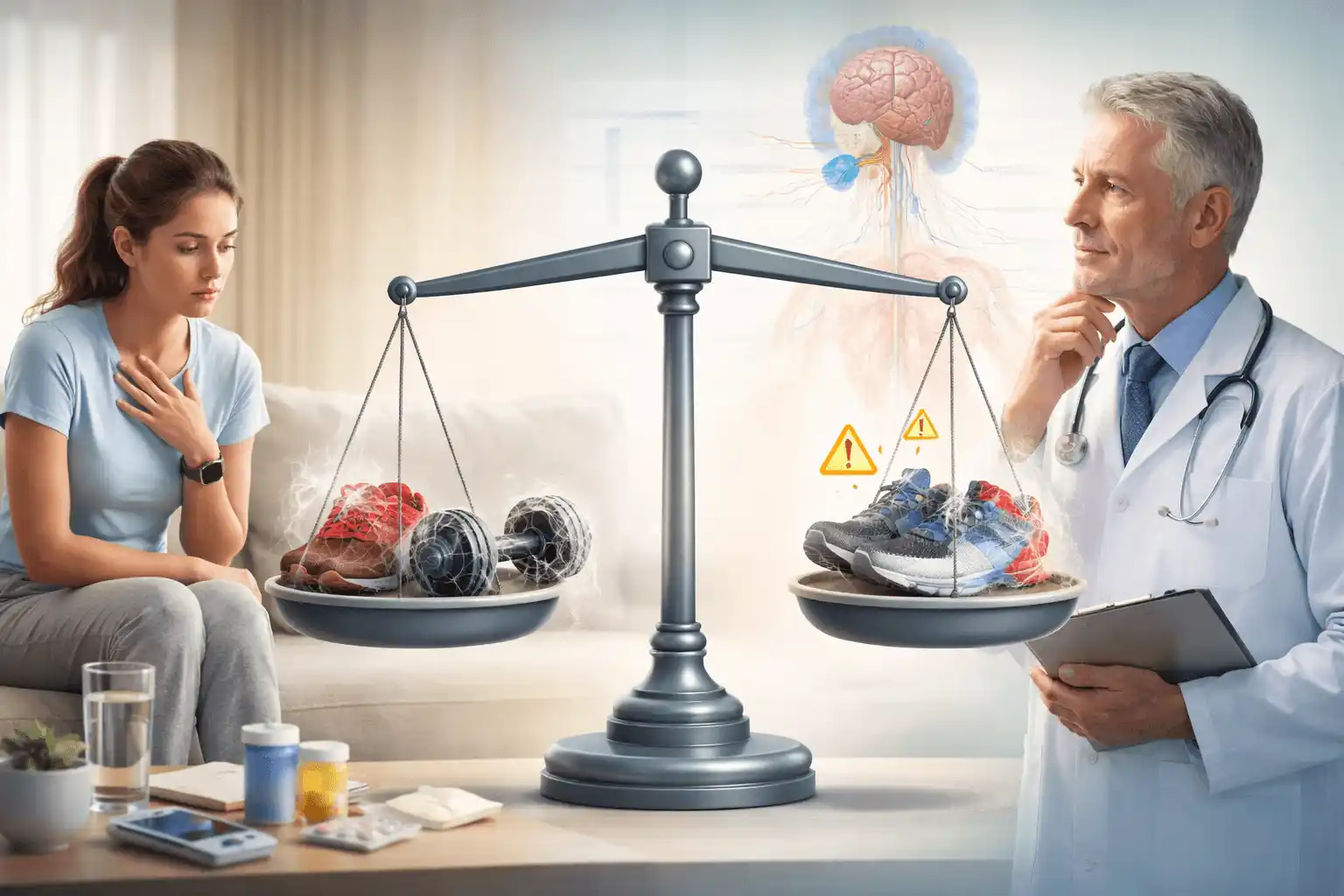
POTS patients face the same challenge. Under-doing causes atrophy in muscles, blood vessels, and metabolic systems. Overdoing overwhelms dysregulated autonomic pathways, leading to crashes that erase progress. Recovery depends on identifying the midpoint where activity can be performed efficiently based on current metabolic capacity.
Vital Scan Testing Reveals Autonomic Balance
The Hope Brain Body Recovery Center uses vital scan testing to assess autonomic function objectively. This testing includes EKG monitoring, blood pressure measurements in the arms and legs, and pulse oximetry on fingers and toes. During controlled breathing exercises, heart rate variability responses are measured.
Healthy autonomic systems show appropriate heart rate increases and efficient recovery, reflecting coordinated sympathetic and parasympathetic activity. When communication between the brain and body is impaired, vital scan data highlights the specific control mechanisms requiring retraining.
Set Realistic New Year Goals
Dr. Schneider’s New Year message emphasizes identifying goals and building realistic strategies. For individuals with POTS, dysautonomia, brain injury, or chronic illness, progress does not come from stacking supplements. It comes from understanding current capacity, identifying system limitations, and retraining autonomic control through targeted rehabilitation.
To learn more about exercise progression, diaphragmatic breathing retraining, and comprehensive dysautonomia rehabilitation, listen to the full episode on My POTS Podcast and visit HopeBrainCenter.com or call 610-544-9800. Recognizing that the autonomic nervous system requires a precise balance between under-doing and over-doing changes how achievable goals are set and sustained in the new year.
Connect with Dr. Joseph Schneider:
Website: Hope Brain and Body Recovery Center; Hope Regeneration Center
Podcast: MyPOTSPodcast.com
LinkedIn: Joseph Schneider
YouTube: HopeBrainBodyRecoveryCenter
Instagram: @HopeBrainCenter_
Facebook: Hope Brain and Body Recovery Center
Related Blog
Duis mi velit, auctor vitae leo a, luctus congue dolor. Nullam at velit quis tortor malesuada ultrices vitae vitae lacus. Curabitur tortor purus, tempor in dignissim eget, convallis in lorem.




Comments